Short answer: they're the same active compound. Lauricidin is a brand of monolaurin sold as pellets you scoop; most other monolaurin products are capsules you swallow. Choose pellets if you need high or finely-adjustable doses and don't mind the taste. Choose capsules if you want convenience, no taste, and a lower cost of entry.
That's the whole decision. The rest of this page is why.
Where we stand, so you can weight this
We stock Ecological Formulas Monolaurin — 300 mg capsules. We didn't formulate it and we don't manufacture it. We're a stockist, which means we have less reason than most people writing these comparisons to tell you the format we happen to sell is the superior one.
For a good chunk of readers it isn't, and we'll say so in the recommendation.
Credit where it's due
Lauricidin was founded by Dr. Jon Kabara — the researcher who did the foundational work on monolaurin's properties in the first place. If you're taking monolaurin at all, it's substantially because of his research.
Lauricidin is a serious product from serious people. You can verify that in thirty seconds, so there's no point in us pretending otherwise.
The comparison
| Pellets (Lauricidin) | Capsules | |
|---|---|---|
| Active compound | Glycerol monolaurate | Glycerol monolaurate |
| Format | Loose pellets, scooped | Pre-measured capsules |
| Typical serving | Up to ~3,000 mg per scoop | 300 mg or 600 mg per capsule |
| Dose adjustment | Very fine — grain by grain | In whole-capsule steps |
| Taste | Soapy. People mention it. | None — capsule masks it |
| High doses | Easy — a scoop or two | Requires many capsules |
| Portability | Tub and scoop | Bottle, travel-friendly |
| Cost of entry | Higher up front | Lower up front |
| Cost per gram at high dose | Generally better | Generally worse |
| Fillers | None | Varies by brand — check |
Where pellets genuinely win
High doses. If you're working up to three or four grams a day, that's one or two scoops of pellets versus a fistful of capsules. At that level pellets are simply more practical, and usually cheaper per gram.
Fine dose control. Pellets let you increase by tiny increments. For someone who reacts strongly to changes and needs to creep upward, that granularity is a real clinical advantage, not a marketing point.
No fillers. Pellets are the compound and nothing else. Capsules need something to fill and flow, and quality varies. If you want to check ours, the full ingredient list is on the product page.
Where capsules genuinely win
You don't taste anything. Monolaurin tastes soapy. Some people don't care. Some people cannot get past it, and for them the best product is the one they'll actually keep taking.
Dosing is unambiguous. Two capsules is two capsules. No scoop, no estimating, no wondering whether you got the same amount as yesterday. For a supplement whose whole protocol depends on a consistent slow ramp, that consistency matters.
Lower cost to find out. A tub of pellets is a real commitment for something you might discover you don't tolerate. A bottle of capsules is a smaller bet on the same question. Ours is $19.50.
Travel. A bottle goes in a bag. A tub and scoop is a project.
The one thing that's oversold
You'll see claims that pellets are meaningfully more absorbable or more potent than capsules. Be skeptical.
It's the same molecule. A capsule shell dissolves in your stomach and releases the compound in the same place a pellet would end up. The legitimate version of that argument is about fillers — a capsule packed with magnesium stearate and silica may dissolve more slowly than one using rice powder — which is a real point about capsule quality, not a point about capsules as a format.
Judge the specific product, not the format.
There's a mirror-image claim on the capsule side worth the same skepticism: that pellets "pass through undigested" because some people report seeing them in stool. That happens, and it's worth knowing, but it isn't a universal property of pellets either.
Which should you pick?
Pick pellets if: you're going above roughly 1,500 mg a day, you need very fine dose control, you've already established you tolerate monolaurin, or you want zero fillers.
That threshold is lower than most comparisons admit, and it's simple arithmetic: at 300 mg a capsule, 2,000 mg a day is seven capsules and a 90-count bottle lasts twelve days. At that point pellets are cheaper and less tedious, and we'd rather tell you than sell you eight bottles you resent.
Pick capsules if: you're trying monolaurin for the first time, you want to know exactly what you took, the taste is a dealbreaker, you travel, or you want to spend less finding out whether this works for you.
Honestly? Most people starting out should start with capsules and switch to pellets if and when they end up needing high doses. We sell capsules and that is still our advice. Establish tolerance cheaply, then optimize the format. Going the other direction — buying a tub first and discovering you can't stand it — is the expensive order to do this in.
Whichever you pick, the protocol matters more
Format is the smallest decision here. What actually determines whether monolaurin does anything for you:
- Ramping slowly. Start at one serving, hold three or four days, step up. People who jump to a full dose feel awful and quit.
- Taking it with fatty food. It's fat-soluble. Empty-stomach dosing is why a lot of people find it unpleasant.
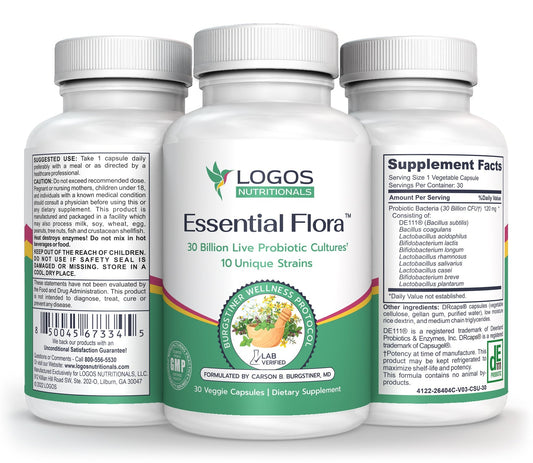
- Repopulating afterward. Monolaurin works on the terrain. If you don't follow with a probiotic like Essential Flora, you've cleared space and left it empty.
- Giving it four to six weeks. Terrain work is slow. A three-day trial tells you nothing.
Get those four right with either product and you'll do better than getting the format "right" and the protocol wrong.
Full detail: the complete monolaurin guide.
Frequently Asked Questions
Is Lauricidin the same as monolaurin?
Lauricidin is a brand name for a monolaurin product sold in pellet form. Monolaurin is the compound. So all Lauricidin is monolaurin, but not all monolaurin is Lauricidin.
Are monolaurin pellets better than capsules?
Neither is better as a format — they deliver the same compound. Pellets suit high doses and fine adjustment; capsules suit convenience, consistent dosing, and avoiding the taste.
Is Lauricidin worth the price?
At high daily doses, the cost per gram is usually favorable. At one to two grams a day, capsules are typically cheaper. It depends entirely on where your dose lands.
Can I switch between pellets and capsules?
Yes. Same compound. Match the milligrams and keep the ramp consistent when you switch.
Which is better for candida support?
Neither format has an advantage. Both support a balanced microbial terrain. What matters is the dose you tolerate, taking it consistently with food, and pairing it with a probiotic.
These statements have not been evaluated by the Food and Drug Administration. This product is not intended to diagnose, treat, cure, or prevent any disease. Lauricidin is a registered trademark of Med-Chem Laboratories. We are not affiliated with them.