Monolaurin is a monoglyceride your body makes from lauric acid — the medium-chain fat that makes up close to half of coconut oil. It's also one of the more studied compounds in human breast milk. As a supplement it's taken to support immune function and a balanced microbial terrain, typically at one to three grams a day, with food.
That's the short version. The longer version is worth reading, because monolaurin is one of the more misunderstood things on a supplement shelf, and most of what's written about it falls into one of two camps: pages that oversell it, and pages that are really just selling a specific brand of it.
Coconut oil isn't monolaurin
This trips up almost everyone.
Coconut oil contains lauric acid. Your body converts some of that lauric acid into monolaurin. The conversion happens, but it isn't efficient, and it isn't something you can push much by eating more coconut oil — you'll hit digestive tolerance long before you hit a meaningful monolaurin dose.
So the tablespoon of coconut oil in your coffee is doing something. It just isn't doing this. A monolaurin supplement gives you the finished compound and skips the conversion entirely.
This is also why "just eat coconut oil" is bad advice that sounds like good advice.
What monolaurin actually does
Here's where most pages start making claims they shouldn't. So let me be precise about what the research shows and what it doesn't.
Monolaurin has been studied extensively in vitro — in laboratory conditions, in dishes — for its effects on lipid-coated organisms. The proposed mechanism is that it disrupts the lipid membrane that certain organisms use as their outer envelope. That research is real, it goes back decades, and it's the reason monolaurin has the reputation it has.
What that research does not establish is what happens in a human body at supplemental doses. Laboratory conditions and a digestive tract are very different environments, and the honest position is that the human clinical literature is thinner than the enthusiasm around this compound would suggest.
What monolaurin is used for, in structure–function terms:
- Supporting immune function — supporting the body's own defenses rather than stimulating them into overdrive
- Supporting a balanced microbial terrain — helping maintain a healthy balance of organisms, particularly in the gut
- Supporting skin and digestive health — both of which follow from that same balance
If you want a supplement with a stack of human randomized controlled trials behind it, monolaurin isn't that supplement, and anyone telling you otherwise is selling. What it has is a plausible mechanism, a long safety record, decades of practitioner use, and a lot of people who report it helped. That's a reasonable basis for trying it. It isn't proof.
How much monolaurin should you take?
There's no FDA-established daily value for monolaurin, which means every number you see is a manufacturer's suggestion rather than an official one.
In practice, most people land somewhere between 1,000 mg and 3,000 mg per day, split into two or three servings taken with food. Some people do fine on less. Others work up considerably higher under practitioner guidance.
Check your capsule strength before you assume a bottle will last. Monolaurin capsules commonly come in 300 mg and 600 mg. At 300 mg a capsule, 2,000 mg a day is seven capsules — a 90-count bottle is under two weeks. That maths catches people out constantly, and it's the main reason pellets get recommended for higher doses. The one we carry is 300 mg.
The number matters less than the ramp.
Start low. This is the part people get wrong.
The most common way monolaurin fails is that someone takes a full serving on day one, feels awful on day two, and throws the bottle away on day three.
Start with one serving daily, with food. Hold there for three or four days. If you feel fine, add a second. Hold again. Keep stepping up until you reach a dose that does something without making you miserable.
If you start feeling worse before you feel better — headache, fatigue, general flu-ish malaise — that reaction is common enough in this category that it has a name, and it usually means you moved too fast rather than that monolaurin is wrong for you. Drop back to the last dose that felt fine. Sit there for a week. Then step up again, more slowly.
People who ramp patiently tend to get somewhere. People who don't tend to quit in week one and conclude it doesn't work.
Should you take monolaurin with food?
Yes, and ideally food with some fat in it. Monolaurin is fat-soluble, so it absorbs better alongside a meal containing fat. It's also easier on the stomach that way — taking it on an empty stomach is the second most common reason people find it unpleasant.
How long does it take to work?
Longer than you want.
Terrain work — changing the conditions in your gut rather than attacking something specific — moves in weeks, not days. Give it four to six weeks at a consistent dose before you decide whether it's doing anything. If you're evaluating it on a three-day trial, you'll conclude it does nothing, and you'll have learned nothing.
Is monolaurin safe?
Monolaurin has a long safety record and is generally well tolerated. It's a compound naturally present in human breast milk and in coconut, which is part of why its safety profile is as clean as it is.
The realistic side effects are digestive — nausea, loose stools, stomach discomfort — almost always at higher doses or on an empty stomach, and almost always resolved by lowering the dose or taking it with a proper meal.
If you're pregnant or nursing, talk to your practitioner before starting. Same if you're managing a diagnosed condition or taking prescription medication. That isn't boilerplate; it's the correct answer.
Where monolaurin fits in a terrain approach
This is where Logos comes at monolaurin differently than most brands selling it.
Dr. Burgstiner's framework — the one this company was built on — is that you don't get durable results by attacking whatever is overgrown. You get them by changing the terrain that let it overgrow. Kill something off without changing the conditions and you've bought yourself a few months.
Monolaurin is a terrain tool. It's not a symptom tool. Which means it works best as part of a sequence rather than as a single bottle:
- Change the conditions. Monolaurin, alongside something like Candida Rid, works on the microbial environment.
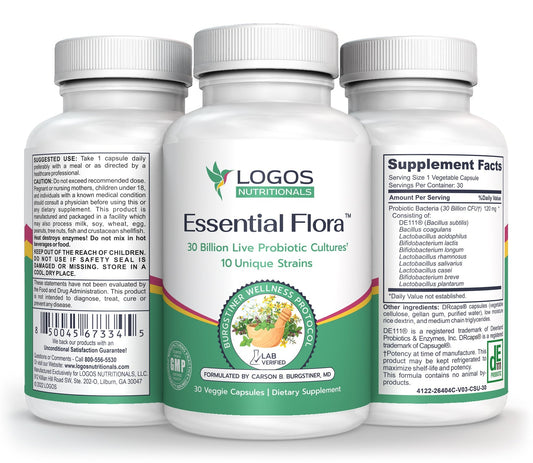
- Repopulate. A multi-strain probiotic such as Essential Flora puts beneficial organisms back into the space you've opened up.
- Hold the ground. Diet and consistency. This is the boring part and it's the part that determines whether step one and two stick.
Skipping step two is the most common mistake. You clear space and then leave it empty, and something moves back in. If you're going to do this, do the whole sequence.
More on the underlying framework: what bio-terrain actually means.
When monolaurin isn't the answer
I'd rather you not buy this than buy it for the wrong reason.
If you want fast symptom relief, this is the wrong category entirely. Terrain work is slow by nature.
If you're taking it as a single bottle with no other changes, expect very little. Monolaurin is a component of an approach, not an approach.
If you're managing a diagnosed condition, monolaurin is not a substitute for treatment and shouldn't be positioned as one — by us or by anyone. Bring it to your practitioner as an addition, not a replacement.
If you've already tried it for six weeks at a reasonable dose and felt nothing, it may simply not be your lever. That's a real outcome and it's fine.
Capsules or pellets?
The other format you'll run into is pellets — small beads you scoop rather than capsules you swallow. Lauricidin is the best-known pellet product.
Same active compound. The differences are dose flexibility, cost per gram, and whether you can tolerate the taste. We've written that comparison out properly here: Monolaurin vs Lauricidin.
Frequently Asked Questions
What are the benefits of monolaurin?
Monolaurin is taken to support immune function, a balanced microbial terrain, and — through that balance — skin and digestive health. Its laboratory research is substantial; its human clinical research is thinner than its reputation implies.
How much monolaurin should I take daily?
Most people take between 1,000 mg and 3,000 mg daily, split across two or three servings with food. There's no established daily value. Start at the low end and increase gradually.
Can monolaurin help with candida?
Monolaurin is commonly used as part of protocols aimed at supporting a healthy microbial balance, which is the terrain candida overgrowth develops in. It supports balance; it isn't a treatment for a diagnosed condition. Most people use it alongside something like Candida Rid and a probiotic rather than on its own.
Does monolaurin cause die-off?
Some people report feeling worse for a few days when starting or increasing. It's common in this category. The fix is almost always to reduce the dose, hold, and increase more slowly — not to stop.
Is monolaurin antifungal?
In laboratory settings monolaurin has been studied for its activity against a range of organisms, including fungal ones. Whether that translates to the same effect in the human body at supplemental doses is not established. As a supplement it's described as supporting a balanced microbial terrain.
Is monolaurin safe during pregnancy?
Talk to your practitioner. Monolaurin occurs naturally in breast milk, but "naturally occurring" isn't the same as "studied for supplemental use in pregnancy," and we won't pretend otherwise.
Does monolaurin cause weight gain?
There's no established link between monolaurin and weight gain. It contributes a negligible number of calories at supplemental doses.
How is monolaurin different from coconut oil?
Coconut oil contains lauric acid, which your body converts into monolaurin inefficiently. A monolaurin supplement is the finished compound, so the conversion step is skipped.
These statements have not been evaluated by the Food and Drug Administration. This product is not intended to diagnose, treat, cure, or prevent any disease.